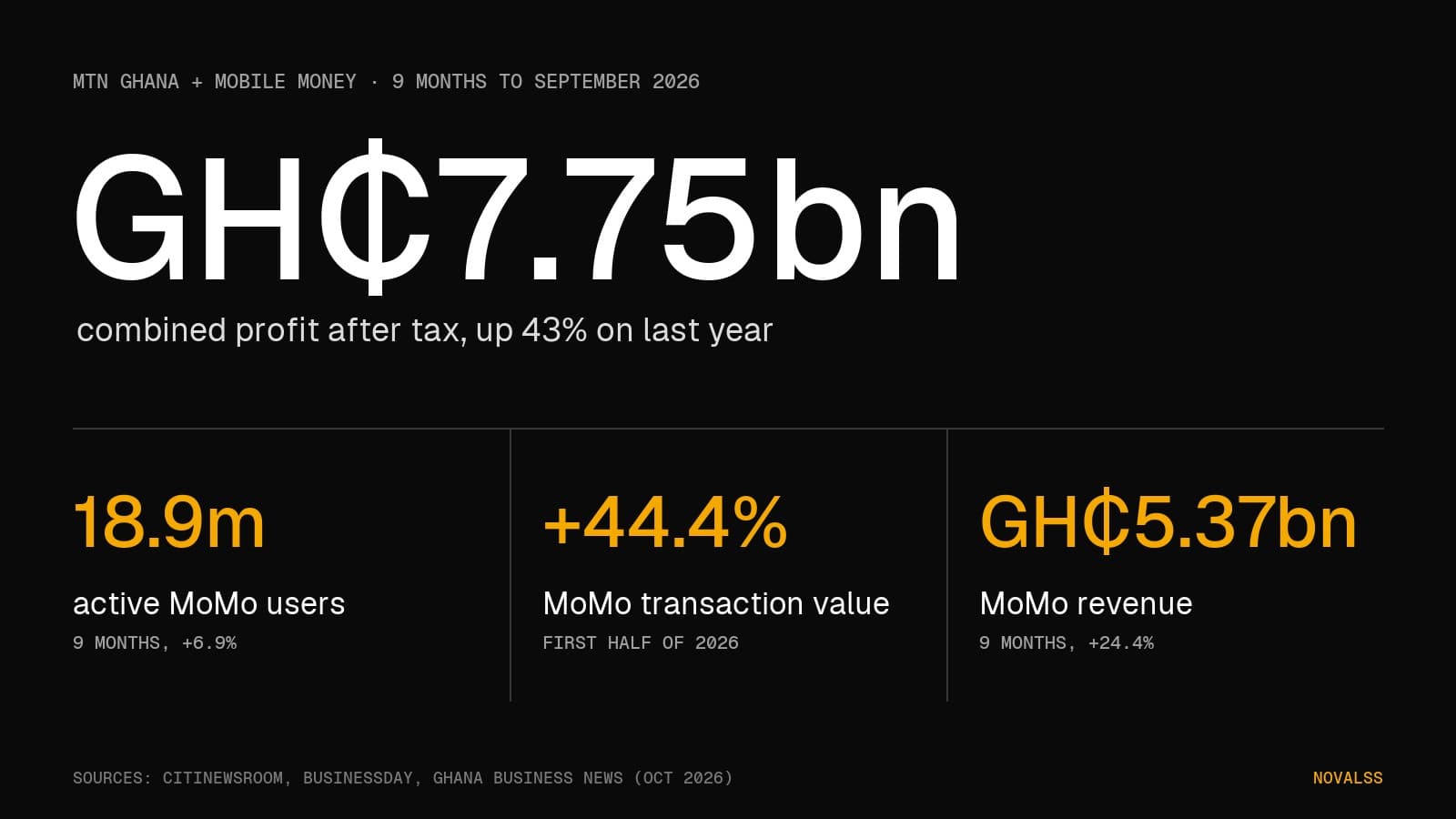
Try it now. Open ChatGPT and type 'best place to buy a laptop in Accra', or 'who builds school software in Ghana', or whatever your customers would ask about your business. Then read the answer carefully. Is your business in it? If not, who is, and why them?
For twenty years, getting found online meant ranking on Google. That still matters. But a growing share of people now ask an AI assistant instead, and get a short answer with three or four names in it. If you're not one of those names, you don't lose a click. You never existed for that customer.
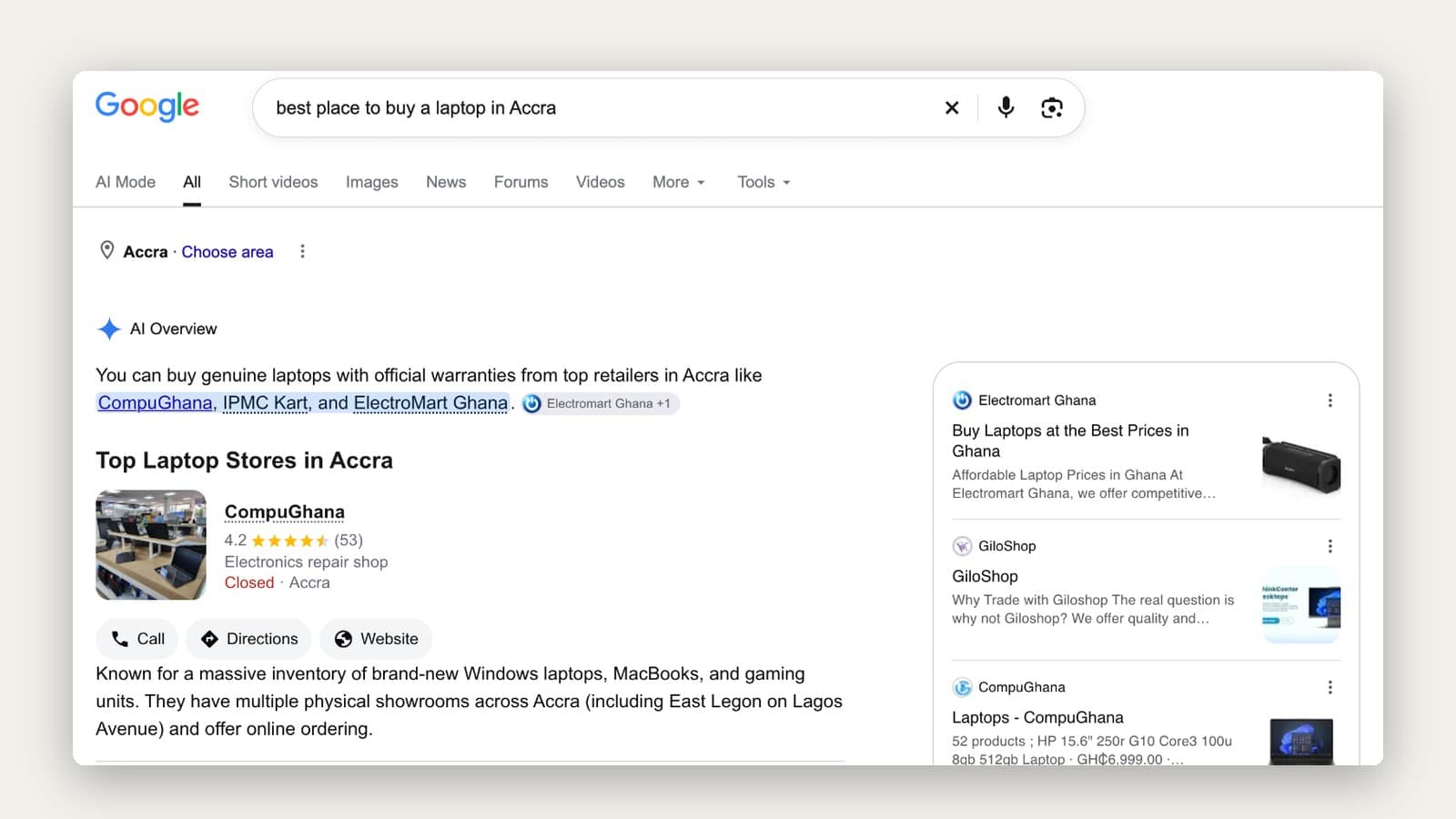
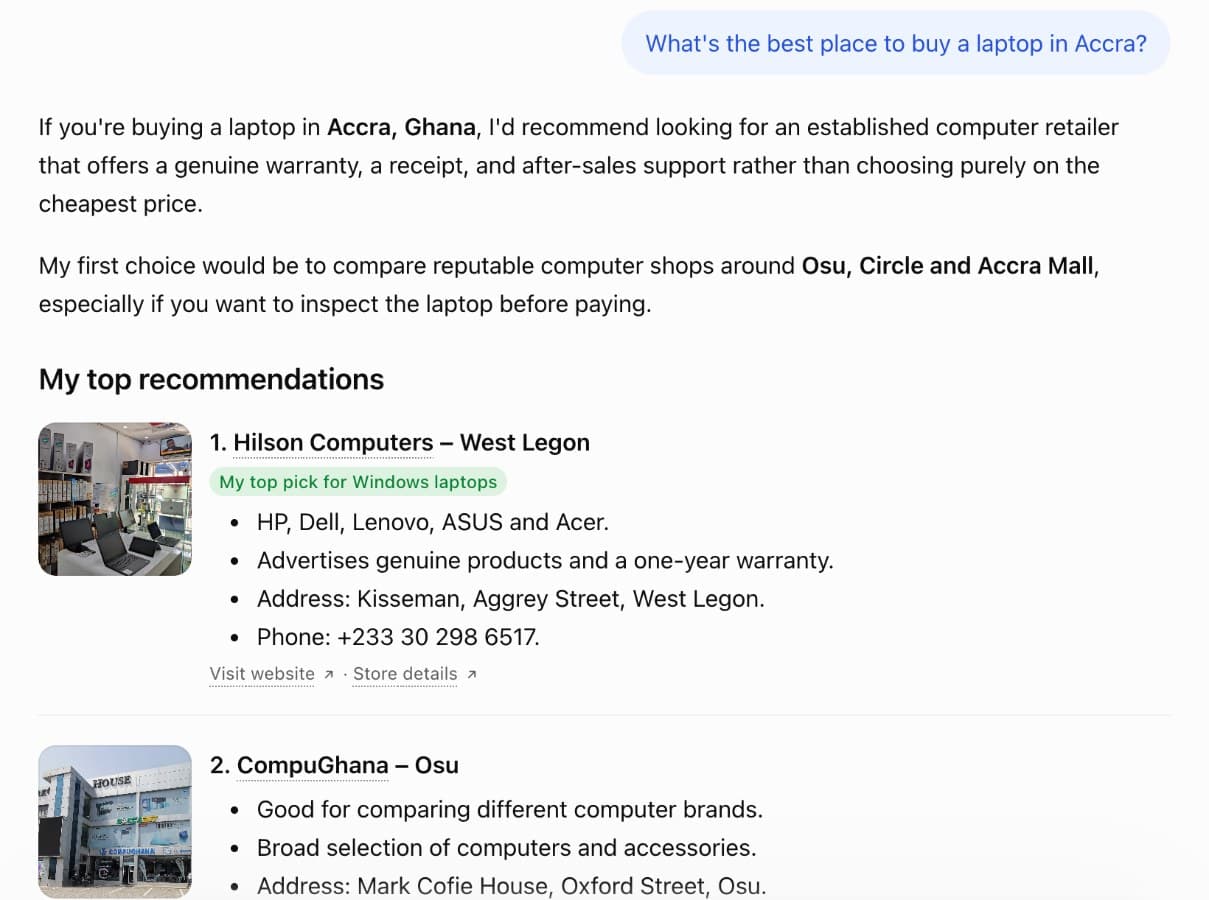
We tried it ourselves on 30 October. Google's AI answer named CompuGhana, IPMC Kart and ElectroMart Ghana. ChatGPT's top pick was Hilson Computers in West Legon, a shop Google's answer didn't mention at all. Same question, same day, different winners. Neither of them listed more than a handful of shops in a city with hundreds.
What's changed this year
Google's own AI answers now sit above the normal results for many searches, and people click less when they appear. A randomised field study by researchers at the Indian School of Business and Carnegie Mellon, run in early 2026 and reported by Search Engine Journal, found AI Overviews showed up on 42% of searches. When they did, clicks out to websites fell by 38%, and searches where nobody clicked anything rose from 54% to 72%. It's a draft paper, not the final word, but every study we've seen points the same way.
ChatGPT has become a shopping tool too. In the US, its shopping answers now lean heavily on product data that stores send it directly. According to tracking by the research firm Profound, the share of product picks coming from those feeds jumped from about 8% to about 62% in a single day in July. In the same period, the ten biggest merchants' share of mentions nearly doubled, and the number of different stores named fell by more than a fifth.
That last part is the warning. When AI picks a handful of answers, the businesses that made themselves easy to read win, and everyone else gets squeezed out.
Why this matters in Ghana
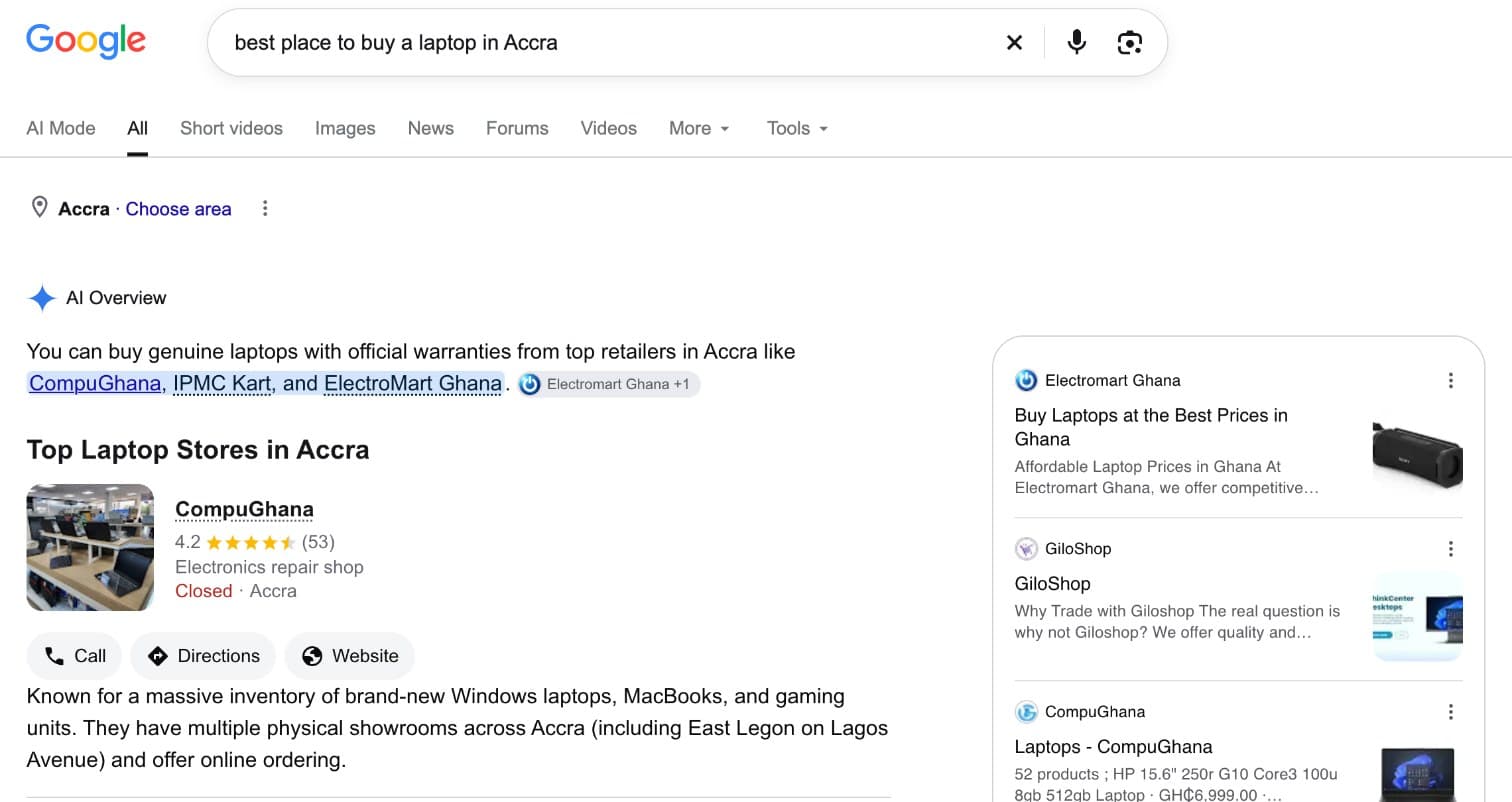
ChatGPT's shopping features are US-first for now, but the habit isn't. Young professionals, students and diaspora customers in Ghana already ask AI where to buy, who to hire and what things cost. Ghana launched its National AI Strategy in April 2026, with the President saying the country won't be 'a passive consumer' of AI. The people buying from you are adopting it faster than most businesses are preparing for it.
And for service businesses, from law firms and clinics to builders and agencies, AI is already the first stop when someone asks 'who should I use?'
How AI decides which businesses to name
There's no secret list you can pay to join. AI assistants answer from what they can read and trust, which mostly comes down to four things.
Your own website, if it says clearly what you do, where, for whom and roughly at what price. Vague slogans give an AI nothing to quote.
What others say about you: Google reviews, directory listings, press, and sites like Clutch. AI treats independent mentions as evidence.
Structured information: your Google Business Profile, and data built into your website that tells machines your name, address, services, prices and opening hours.
Freshness and consistency. If your phone number, address and services match everywhere, you look real. If three listings disagree, you look risky.
Nine things to do about it
1. Ask the AI yourself. Put five questions your customers would ask into ChatGPT, Gemini and Google. Write down who gets named. That's your real competition now.
2. Say plainly what you do on your website. 'We supply office furniture to businesses in Accra and Tema, delivered in 48 hours' beats 'Excellence in every detail'. AI quotes sentences, not slogans.
3. Publish your prices, or at least starting prices. 'How much does X cost in Ghana' is one of the most common questions people ask AI. If you're the business that answers it, you get named.
4. Answer the real questions. A good FAQ written in your customers' own words gives AI ready-made answers to lift, with your name attached.
5. Fix your Google Business Profile. Correct category, real hours, real photos, the right pin on the map and a description that says what you do.
6. Get reviews, with words in them. A five-star rating with no text tells an AI nothing. 'They delivered our school portal in three weeks and trained our staff' tells it a lot.
7. Be listed where AI looks. Respected industry directories and review sites count as independent proof. One good listing beats twenty spammy ones.
8. Don't block AI from reading your site. Some website setups block AI crawlers by default. If OpenAI's search crawler can't read your pages, ChatGPT can't recommend you from them. Ask whoever manages your site to check.
9. If you sell products, keep your product data clean. Real names, prices, stock levels and photos for every item. As AI shopping reaches more countries, the stores with tidy product data will be the ones it can show.
What we've done on our own site
We practise this on novalss.com. Our prices are published. Our service pages carry the structured data AI and search engines read, and each one answers the questions clients actually ask us. We keep a plain-text summary of the company for AI tools, and our case studies name real clients and what we built for them. None of it is a trick. It's just making it easy for a machine to understand and trust a business, which turns out to be the same thing that makes it easy for a person to.
Isn't Google SEO dead, then?
No. Google is still where most searches in Ghana start, and AI tools lean on the same signals Google does: clear pages, real reviews, consistent details, fast mobile sites. The good news is that the work overlaps almost completely. A website built to be understood by people and machines does well in both. A website built only to look nice does well in neither.
The difference is that the reward is now more concentrated. Being fifth on Google still got you some clicks. Being fifth when an AI names three businesses gets you nothing.
If you'd like to know how your business shows up when customers ask AI, book a free call. We'll run the questions with you, show you what AI sees, and tell you plainly what your website needs to change.
Want help putting this into practice?
Tell us what you're working on. We reply within 24 hours with a plan and a fixed price.
Start a project