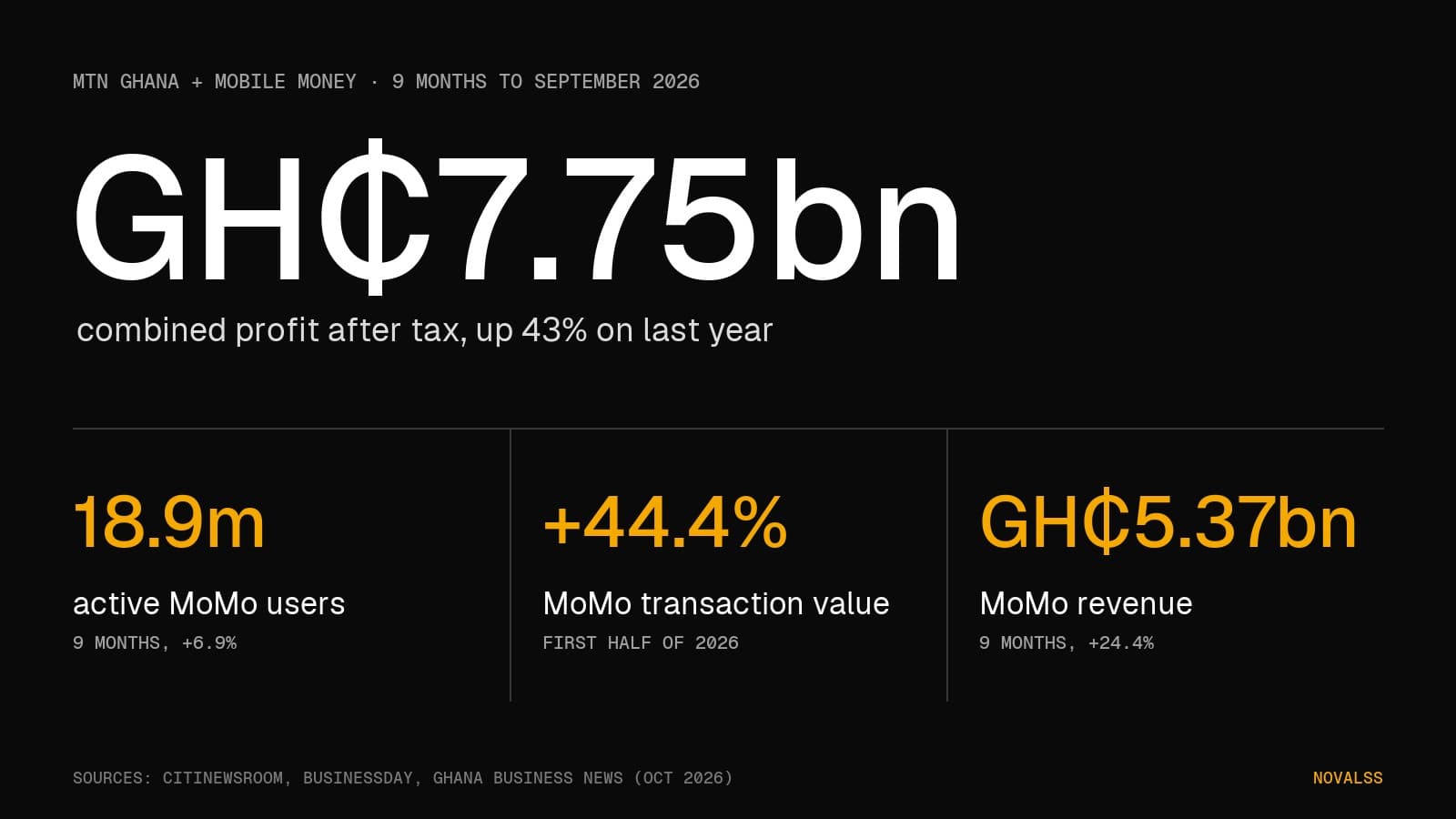
This week MTN Ghana and its Mobile Money company reported a combined profit after tax of GH₵7.75 billion for the first nine months of 2026, up 43% on last year, according to Citi Newsroom. Active MoMo users rose to 18.9 million. Earlier this month, MTN said the value of transactions on MoMo grew 44.4% in the first half of the year.
You don't need to care about MTN's profits. But you should care about what they tell you: your customers already pay by MoMo, more of them every quarter, and in bigger amounts. The question is whether your business is set up to take that money properly, or whether it's still running on screenshots, personal numbers and someone checking a phone.
What the numbers actually say
18.9 million active MoMo users is most of Ghana's adult population. MoMo revenue grew 24.4% to GH₵5.37 billion over the nine months. BusinessDay reports that MTN's chief executive, Stephen Blewett, pointed to 'increasing fintech adoption' as one of the drivers.
Put simply: paying by MoMo is no longer the alternative. For most customers in Ghana, it's the default. A business that makes MoMo payment slow, awkward or uncertain is making the most common way to pay it harder than it needs to be.
How most businesses still take MoMo
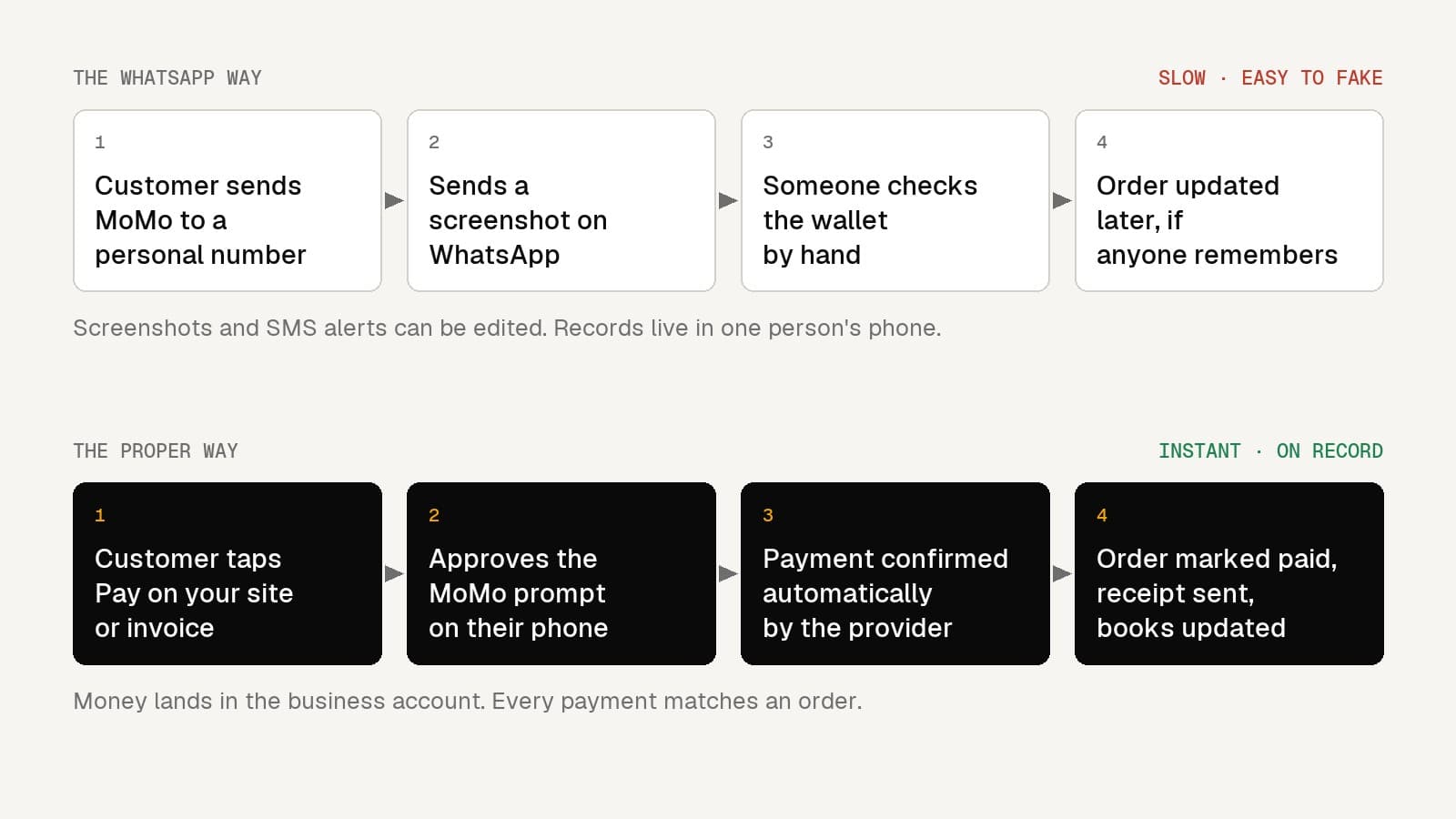
You know the routine. The customer sends money to a number, usually someone's personal line. They send a screenshot on WhatsApp. Someone opens the wallet to check it really arrived. Then, eventually, the order gets marked as paid, if anyone remembers.
It works when you have ten orders a week. It breaks as you grow. Screenshots and SMS alerts can be faked, and fake payment alerts are one of the oldest tricks in the book. Staff spend hours matching payments to orders. When the person holding the phone is away, nobody can confirm anything. And when they leave, the payment history leaves with them.
The Zeepay lawsuit every business owner should read
Also this week: the fintech company Zeepay and its managing director sued MTN Ghana and Mobile Money Fintech Limited at the High Court in Accra, claiming GH₵15 million plus damages, according to Ghana Business News and Tech Labari.
Zeepay says a business wallet it opened in 2023, using the company's own registration documents, came out showing the managing director's personal name instead of the company's. Customers paying into it saw his name. Zeepay says it has asked for the name to be corrected since November 2023. MTN had not commented publicly at the time of the reports, and the court will decide who's right.
Whatever the outcome, the lesson for the rest of us is simple. If a fintech can spend three years trying to get the right name on its business wallet, check yours today. Whose name do your customers see when they pay you? If it's a staff member's, or yours personally, that's a problem for trust, for your records and for the day that person isn't around.
Six ways to take MoMo properly
1. Use a business wallet or merchant account in the company's name. Not the owner's line, not the shop manager's. Check the name a customer sees when they pay.
2. Stop accepting screenshots as proof. A screenshot proves nothing. Either check the wallet itself, or better, use a payment system that confirms payments for you.
3. Let customers pay at checkout. A payment provider such as Paystack puts MoMo and cards on your website, invoices or payment links. The customer approves a prompt on their phone and the payment is confirmed automatically. Paystack's published fee in Ghana is 1.95% per successful payment.
4. Connect payments to orders. When a payment is confirmed, the order should be marked paid on its own, the customer should get a receipt, and your records should update. No one should be copying numbers from one phone to another book.
5. Keep business and personal money apart. It makes your accounts readable, your tax simpler and your business easier to value if you ever want a loan or an investor.
6. Control who can see and move money. One person with the PIN is a risk. A proper system gives staff the access their job needs and keeps a record of who did what.
What this looks like in practice
For a shop, it's an online store where customers pay by MoMo or card at checkout and the order lands, already paid, on your dashboard. BossLady Klasik runs this way. For a service business, it's payment links on invoices that mark themselves paid. For a business that collects money from many people, such as school fees, rent, contributions or weekly payments, it's a system that matches every MoMo payment to the right person automatically and chases the ones that haven't paid.
We've written a fuller guide to selling online in Ghana with Paystack, MoMo and delivery if you're starting from scratch.
If your business still confirms MoMo by screenshot, book a free call. Tell us how you get paid today, and we'll show you what it would take to make every payment confirm itself, with a fixed price in writing within 24 hours.
Want help putting this into practice?
Tell us what you're working on. We reply within 24 hours with a plan and a fixed price.
Start a project